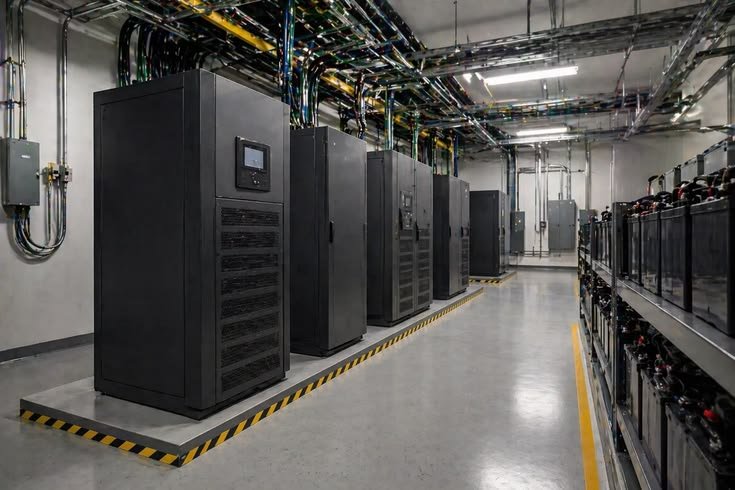
AI Data Centers Are Driving a New Demand for Large-Diameter Piping and Flanges
When people talk about the massive AI infrastructure buildout, the conversation usually centers on GPUs, data centers, electrical power, land, and megawatts.
But there is another critical infrastructure component keeping these facilities operating: cooling.
As AI workloads continue to increase computing density, data centers are generating substantially more heat. Traditional air-cooling systems are becoming less practical for many high-density applications, accelerating the adoption of liquid-cooling technologies such as direct-to-chip cooling, rear-door heat exchangers, and other advanced thermal-management systems.
Behind these technologies is an extensive industrial piping network.
That is where large-diameter piping, pipe fittings, valves, and flanges become an essential part of the data center infrastructure.
For companies involved in piping procurement, fabrication, engineering, and supply, the growth of AI infrastructure represents a significant emerging opportunity.
Why Data Center Cooling Is Becoming a Piping Problem
A modern hyperscale or AI-focused data center can contain thousands of high-performance servers operating at extremely high power densities.
The heat generated by these systems has to be transferred away continuously and reliably.
Liquid cooling is increasingly being used because liquids can transfer heat much more efficiently than air. However, cooling the processor is only one part of the system.
The heat ultimately has to travel through a building-scale thermal-management system that can include:
- Chilled-water piping
- Condenser-water piping
- Cooling towers
- Chillers
- Pumps
- Heat exchangers
- Distribution headers
- Control valves
- Pipe fittings
- Flanged connections
- Mechanical equipment connections
In large facilities, these systems can involve substantial quantities of piping and hundreds or thousands of individual connection points.
Every connection between piping, valves, pumps, chillers, heat exchangers, and other equipment creates another requirement for properly selected and specified flanges.
Large-Diameter Headers Are at the Center of the System
The piping inside a data center cooling system is not simply a collection of small utility lines.
Large facilities can require significant-diameter distribution headers to move high volumes of cooling water throughout the building and between mechanical systems.
Depending on the facility design, piping can range from relatively small branch connections to large headers measuring several feet in diameter.
The larger the piping becomes, the more important proper flange selection, dimensional accuracy, bolt patterns, pressure ratings, material specifications, and delivery schedules become.
A flange that does not match the required standard or drilling pattern can create significant installation problems—particularly when it is connected to large and expensive mechanical equipment.
For that reason, flange requirements should be established during the engineering and procurement stages rather than left until fabrication or installation.
Chilled Water and Condenser Water: Two Different Applications
One of the most important considerations when specifying cooling-system piping is understanding the application.
Chilled Water Systems
Chilled-water systems generally circulate conditioned water between chillers and cooling equipment.
Because these systems are typically closed-loop systems, water treatment and corrosion control can be managed more effectively.
The piping and flange specification will depend on the project’s:
- Operating pressure
- Temperature
- Pipe diameter
- Material
- Applicable codes and standards
- Equipment connections
- Project specifications
For many projects, ASME-standard flanges may be used for equipment and piping connections, while large-diameter waterworks applications can introduce AWWA standards into the specification.
Condenser Water Systems
Condenser-water systems are used to transfer heat from the cooling system to cooling towers or other heat-rejection equipment.
Unlike a closed chilled-water loop, condenser-water systems can have different operating and water-treatment conditions. Makeup water, oxygen exposure, water chemistry, and environmental conditions can influence material and coating requirements.
That makes correct material and flange selection particularly important.
Where AWWA Flanges Enter the Picture
Large-diameter cooling-water systems can involve more than traditional ASME process-piping standards.
Depending on the project specification and application, AWWA standards may be relevant for large-diameter water-service piping and flanged connections.
Standards such as AWWA C207 address steel pipe flanges for waterworks service, while other AWWA standards address steel and ductile-iron pipe and related components.
This creates an important distinction for procurement teams.
A large-diameter flange should not be specified simply by saying “20-inch flange” or “36-inch flange.”
The procurement specification may also need to identify:
- Flange standard
- Pressure class
- Nominal pipe size
- Outside diameter
- Bolt-hole pattern
- Bolt-hole diameter
- Number of bolt holes
- Flange thickness
- Facing requirements
- Material
- Coating requirements
- Applicable project specifications
A flange manufactured to the wrong standard may physically resemble the required component but still fail to match the mating flange.
That is why standard compatibility matters as much as size.
ASME vs. AWWA: Why the Difference Matters
ASME and AWWA flanges are not interchangeable simply because they have the same nominal pipe size.
Their dimensional requirements, pressure classifications, drilling patterns, and intended applications can differ.
For data center cooling projects, engineering and procurement teams should determine early whether the system requires:
ASME flanges
Typically associated with process piping, equipment connections, and applications governed by ASME standards.
AWWA flanges
Commonly associated with waterworks and large-diameter water-service applications where the project specification calls for AWWA standards.
The correct selection ultimately depends on the engineering design, applicable codes, project specifications, and the piping system’s operating conditions.
What Data Center Buyers Should Confirm Before Ordering
The rapid construction schedules associated with data center projects make procurement accuracy especially important.
Before placing an order for large-diameter flanges or piping components, buyers should confirm the following:
Decision Point | What to Confirm |
Application | Chilled water, condenser water, or another cooling service |
Standard | ASME, AWWA, or project-specific requirements |
Size | Header, branch, equipment connection, or specialty connection |
Pressure Rating | Actual operating and design pressure |
Material | Carbon steel, stainless steel, ductile iron, or specified material |
Facing | Required flange facing and mating configuration |
Drilling | Bolt-hole diameter, quantity, spacing, and pattern |
Coating | Interior/exterior coating requirements where applicable |
Quantity | Total requirement by size, class, and configuration |
Lead Time | Manufacturing and delivery requirements |
Documentation | MTRs, certifications, dimensional information, and project documentation |
Getting these details right at the beginning can prevent expensive changes later.
Why Large-Diameter Flanges Can Become a Project Bottleneck
Large-diameter components are not always readily available from standard inventory.
As the diameter increases, manufacturing, handling, transportation, storage, and production scheduling become more complicated.
A project requiring dozens of large-diameter flanges may therefore need advance planning to ensure the components are manufactured and delivered when the piping contractor needs them.
This becomes even more important during periods of high construction activity, when multiple industrial, infrastructure, energy, and data center projects may be competing for manufacturing capacity.
For data center contractors and procurement teams, lead time should be treated as part of engineering and project planning—not simply purchasing.
The Growing Opportunity for Piping Suppliers
The AI infrastructure boom is creating demand far beyond servers and electrical equipment.
Every new high-density data center requires a physical infrastructure capable of managing enormous amounts of heat.
That means opportunities for companies supplying:
- Large-diameter pipe
- Weld neck flanges
- Blind flanges
- Slip-on flanges
- Threaded flanges
- AWWA flanges
- Pipe fittings
- Valves
- Pumps and related components
- Fabricated piping assemblies
- Cooling-system components
For piping suppliers, fabricators, contractors, and engineering firms, understanding data center cooling requirements can create an important new market opportunity.
The Bottom Line
The AI infrastructure revolution is also an infrastructure story—and cooling is one of its most important pieces.
As computing densities increase, liquid cooling and large-scale thermal-management systems are becoming increasingly important. Behind those systems is a network of chilled-water and condenser-water piping, mechanical equipment, valves, fittings, headers, and thousands of connection points.
And wherever large piping connects, flanges matter.
The key is not simply finding a flange that matches the pipe diameter. The correct component must match the standard, pressure class, material, dimensions, drilling, facing, and project specifications.
For data center projects, getting those details right early can help avoid costly procurement and installation delays.
STU Piping supports industrial piping requirements with a focus on quality, specification accuracy, and dependable supply. If you are sourcing piping components, large-diameter flanges, or water-service piping for a data center or industrial project, contact the STU Piping team to discuss your requirements.